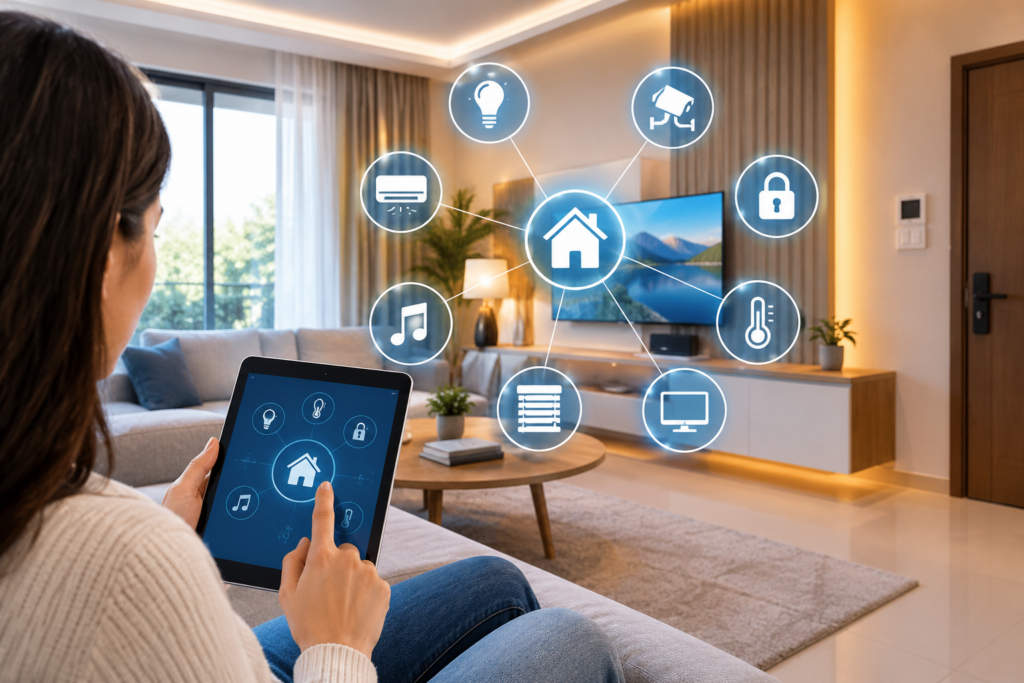
Making the conversion of a simple household into a smart home can enhance our everyday lives in ways that are convenient, comfortable and connected. Automation is able to combine a few functions under one control roof, such as controlling the lights, air conditioning, security system, curtains, entertainment devices, and many other electrical systems. But having the appropriate arrangement does not only entail purchasing smart devices and being able to connect them.
These are all factors that can impact operation in time for the system, such as planning, compatibility, installation, programming and after-sales support. The right questions to ask before the project begins are important; hence, it is important to work with the right Home Automation Company in Chennai. With proper communication with the service provider, you will also understand what will be installed, how the system will function, the degree of control you will have, and the support you receive once the installation is complete.
Each home is unique, and the first question should be regarding the solutions that the company provides. Some homeowners might just want auto-lights and others might wish for an entire “smart home” system comprising security, climate control, entertainment, curtains and access controls. Inquire about the options the company has and if they can be adapted to your house. A good discussion at this point will create good awareness of whether the company can work the entire project or just segments of it.
Here are a few typical home automation solutions:
The devices used for the automation of a smart home are not universal, but are rather typed by the type of home automation used to control them. With a compact apartment, the way of approach may be different from that of a large independent house or villa. The family’s routine and preferences will be different within the same property. Discuss it with the Home Automation Company in order to find out if there is a possibility to build your system in a way that can blend your room layout, the electrical system already installed and future demands.
One feature you might want to include is that the lights in the living room open and close the door to them. Consider having the air conditioner run on a schedule or even have a single scene to dim the lights, close curtains, and switch on entertainment when it’s bedtime. The greatest advantage of it is that it can be used for customisation, which means that you do not need to automate everything in your house. It’s okay to concentrate on the functions that will facilitate everyday life; more functions can be added later if needed.
Before installation, one of the important points to clarify is that it is compatible or not. The smart home could be equipped with any number of devices, from any class and sometimes, different makes. Without this proper communication working, you might end up with multiple distinct apps or control systems. Find out what communication protocols, platforms, and/or control systems the company plans to use, as well as whether any products the company intends to use are compatible. If possible, it will be a great help to avoid any possible compatibility issues after installation. It also helps you to understand how your smart home will work as a system, instead of just a bunch of independent devices.
You can also ask:
Also Read This: 10 Reasons Why Home Automation Is the Future of Modern Living
One more important aspect where homeowners should seek clarification is installation. It can be electrical wiring, control panels, sensors, switches, network connections, and programming and device configuration, depending on the type of automation system. Have the company detail how it’s going to be installed so that the project doesn’t get off to a bad start. The automation needs could be a factor when designing a new house, or even in the initial design phase. The company can recommend wired, wireless, or hybrid solutions to the existing home, depending on the particular home.
How much it will upset the balance probably always helps to think about as well. It can help make a project easier to handle if you know the expected timing, which areas to expect access to and if there are electrical changes in the area that need to be made. The task of a professional installation should not be limited to connecting devices. Correct configuration and testing are also crucial in making sure that the system is working in accordance with the requisite functions.
Home automation must be easy to use. Review how control of the various functions will be accomplished after installing the system before making a selection. System control can range from smartphones to tablet technology, touch panels, remote control, voice, sensors, to scheduled automation. For example, you might have a “Good Morning” scene that opens particular curtains and turns on certain lights. A “Movie” scene would turn off the lights, draw the curtains and switch on the entertainment system. The scenes can minimise having to run each device individually. Enquire with the Home Automation Company if these scenes are available for further personalisation and modification in the future. It is also important to grasp the implications of a lack of connectivity and whether key operations are able to be managed locally.
Smart devices are plugged into your home network, and depending on what they can do, they can store or share data. Thus, from the outset, a discussion of security should take place. Enquire about how the automation system is safeguarded and suggest methods for connected device and user protection. Where your automation system is linked with CCTV, smart locks, video doorbells or other security control units, the features of who accesses what and the permissions or access of those people are even more vital. Also, you should find out what information is saved to disk and whether it can be processed in the cloud or not. Having this information beforehand means you’ll have a better understanding of your smart home system before its installation.
It’s not a bad idea to ask some of the following questions:
It is important to note that it is not the end of the road with the Home Automation Company after the installation. Over time, such as when software needs patching, troubleshooting, reconfiguration, or pieces of the system need upgrading, smart home systems could need software updates, troubleshooting, reconfiguration, or replacement. When close to completing the project, enquire about the type of after-sales support. Ask the company if they offer system upgrades, on-site support, remote assistance, troubleshooting and maintenance services. It is also important to enquire about the warranty on the products and installation.
Each component could come with a different warranty period; if this information is provided on paper, then it shouldn’t cause any confusion later on. Additionally, ask if the business can change the automation settings in case your needs evolve. For example, you may initially automate only lighting and curtains but later decide to integrate air conditioning, security, or entertainment systems. When you’re purchasing a new system to become a part of your day-to-day life, dependable support can make a huge distinction.
“A well-planned smart home is built around your lifestyle, not around a list of gadgets.”
Make a detailed proposal; don’t just accept a general quote before starting the work. Things can get expensive, so the overall home automation price might differ based on the number of rooms covered, devices installed, wiring needs, control systems, integration and level of customisation. It’s also nice to talk over the timeline of the project and anticipated stages of completion. When installing a new home, schedule your new projects to ensure that they are well managed, especially when it comes to installing your other projects such as electrical, interior, networking and more. Do not only consider the cost, but also think about what you have in the package so you can be better equipped to compare the packages. A clear proposal should include what is included in the project, and what might come with extra costs.
Ask about:
Planning a home automation system around how you would actually use a home will make it an effective feature of your daily existence. A properly designed mix of controls, sensors, connected devices and automation scenes can eliminate repetition and provide you with more control over various spaces of your home. However, there is more to the final resulting setup than just the devices. Don’t hire a Home Automation Company in Chennai without asking the above questions, which include solutions, customisation, compatibility, installation, ways to control, security, maintenance and price. Having a detailed discussion from the start can help you understand what you are buying and what you are not.
Looking for Home Automation Systems in Chennai? Our Infex Automation is known to be best Home Automation Company in Chennai provide top Home Automation in Chennai. We are well known for Smart Home Automation, Smart Gate Automation, Wired Home Automation, Wireless Smart Home Automation, Curtain Automation, CCTV and Security Systems, Digital Door Lock Automation, Video Door Phone Installation Services, OTS Automation, Audio Visual Solution Providers in Chennai..
Copyright © 2025 Powered by Infex Automation . Design and Developed by